What follows are excerpts from a first draft of a novel I was writing about the idea of an extraterrestrial signal being discovered.
I have begun to re-imagine the book, but I've decided to post up these excerpts because they were fun to write. I hope they are just as fun to read.
Author’s
note regarding abbreviations:
SETI
– (the) Search for Extraterrestrial Intelligence
ETI
– Extraterrestrial Intelligence
PART 1: DISCOVERY
I
meet Dr Joseph Lesley at the Arecibo Radio Observatory, in Puerto
Rico. After a brief look around the visitor's centre (which has a
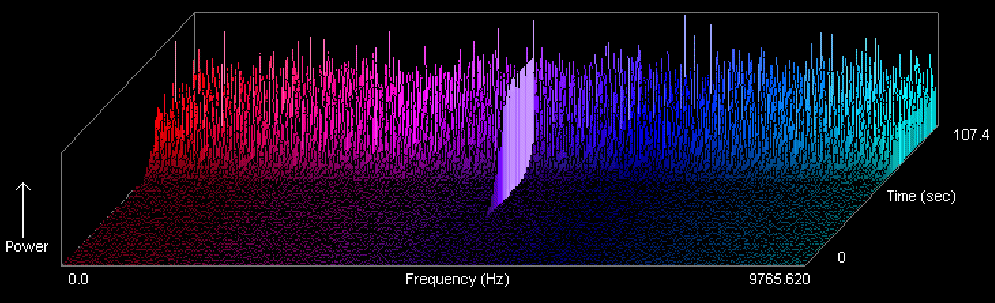
very large display of the original signal signature in the foyer,
which looks like a strange 3D multicoloured
graph) he takes me on a short tour of the complex, explaining quite
technically what goes on here. He explains some of the semantics of
the graph, which comprises of three axes: Time, Power and Frequency.
It mostly looks a mess, apart from just to the left of the centre, in
which rises a strong uniform column. A clear indication of an
intelligent signal, I am told. I'm very much lost in the physics and
technological jargon, but I try my best to smile and nod in the right
places. Truth be known, I'm a bit awe struck. I feel like a child
who's met Columbus after his return from the Americas.
We’re
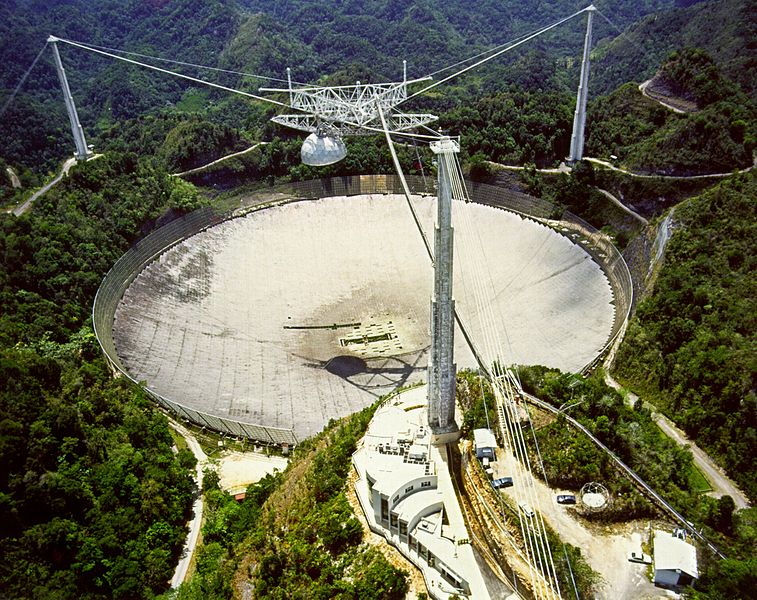
stood on the walkway overlooking the giant 1000 ft dish.
I
think he realizes he's going a bit over my head, and decides to
settle down to the story I'm truly here for.
"I
know the first question on every one's lips,” he says, looking as
if he can read my mind. "If it was from that close to us all
along, why didn't we notice it sooner? Well, there are a lot of
reasons.
“Firstly,
one of the major myths of SETI is that it is an organization. NASA
did set up the SETI project many years ago, but that project was
disbanded. Since then the SETI institute has been a privately funded
affair, with donors such as microsoft’s Paul Allen. However, SETI
is just an umbrella term for a project being undertaken by many
different organizations. There is no real centralization. Certainly,
the SETI Institute is seen as a galvanizing force, and central point,
because of the funding we have, but we are by no means a true
headquarters of an organization calling itself SETI. This means that
there is a lot of talk going on between the various factors, which
can make any signal’s confirmation quite lengthy.
“Secondly,
we just didn't have the means. The SETI projects have long been
looking for a signal in the microwave frequency band, one that would
not be confused with any other natural 'background noise'. We didn't
have the means to accurately discern any normal communications
transmissions - things like TV broadcasts - from anything else out
there. We assumed though, and still assume to some degree that
someone out there would use this narrow band signal. Part of this is
because we believed - and again still believe - that there may be
some form of life sending signals out to the universe about their
existence, and this method makes most sense. But they
weren't sending that signal out. It was only recent technological
breakthroughs that allowed us to truly ‘eavesdrop’ on ETI. Their
‘near closed’ communication paths - an increasing trend that we
see in our own communications network – would have been impossible
to listen to just 30 years ago.
"Thirdly,
and tied in with this is an exposure of the myth of SETI - that myth
being that we're just a bunch of UFOlogists spending all our time
looking for little green men. In fact, most of our time is spent
listening to noises that aren't from ETI, but are just natural
phenomena, and cataloguing them. We also look at people's submissions
of possible signals, and ritually debunk them - not maliciously, just
because it's not ETI (sometimes it still turns out to be something
amazing though, or at least something that enables us to recalibrate
our ideas for future searches – such as what happened at
Greenbank). SETI does as much to point out that there isn't Alien
life out there as it does to find it, much to our dismay. We are
scientists, and as such we don't jump on the first 'Wow' signal and
start proclaiming we've found ETI. Each one has to be investigated
and either verified or, in 99.9% of cases falsified. In this process
we do a lot of other astronomy, finding new objects in the cosmos. We
even do a lot of work finding extra solar planets.
"That's
what took us so long to find a signal. We didn't have the means to
discern it, and so any noise we got from that part of the cosmos we
couldn't feasibly say was ETI. Even when we detected the first
evidence of an extra solar planet out there, we weren't able to tell
if we were hearing anything from ETI. Finding a planet is much easier
than finding any signs of intelligent life, though we’re getting
better."
"Our
main problems were with the Software and Hardware. Technology
certainly has come a long way since we started this project. Once we
had the means we were away. Not over night, you understand. It was a
while before we looked back over the Centauri system. Even then, we
weren't as advanced as we are now - the signal was still faint, but
we could discern it.
"When
SETI first started we couldn't tell ETI from much else around us.
Now, given time to decode the signal, we could watch their TV."
We certainly have come a long way. It is a very sobering thought, given past events. Our technological evolution has been bitter sweet in our very recent history. Many of us wonder if fate played us a cruel hand. Dr Lesley, though, is optimistic of the future - even if a little somber at the immediate loss. "Lessons have been learnt, and we have to move on with them," he tells me.
He espouses the notion that all here is not lost. He may be right, but only time will tell.

As
we stand there, we begin reminiscing about the start. I'm forced to
ask why it took so long to become public knowledge.
"Well,
I wouldn't say we took very long. We first got the signal on June
5th. There were strict procedures to go through before going anywhere
near the public domain with it. Like I say, we spend most of our time
ascertaining that possible signals aren't actually from ETI. Take the
1997 Greenbank signal. We tracked that for about 24 hours before we
realized it was just the SOHO satellite. The signal doesn't come
through and switch on a big light in the room labeled "ETI
Calling". If anything, there's a lot of little lights that
gradually get turned on, from "it's probably just a quasar",
through "it looks slightly less natural", up to "we're
about as certain as we can be that this is it" - and then we
start trying to decode it. Even then, we still have to be ready for
an elaborate hoax, or something else outside our present reference.
"Remember
the first planet hunters? The Swiss team took forever to disclose
their findings. For one thing, there had been so many false starts,
they didn't want to jump the gun. Also, they didn't want anybody else
to get there first if they gave away too much. Mind you, the latter
wasn't something we could afford to worry about, but the former was
very much on our mind through almost the whole discovery process.
“In
fact, this thing hit the public domain long before we were even
confident."
He's
right, within 48 hours of the discovery, tentative reports were
leaking into the media about evidence of Alien life. Even the world's
broadsheets were publishing small articles in their science
supplements about the discovery and its possible causes. In fact, it
was the journalistic realm of gutter press - the kind that headlines
"My Hubby's an Alien" every week - that actually had its
heyday in being right for once. Though only because they'd always
jump the gun on these issues.

“Seth
Shostak wrote a paper on this back in 2000. It was about the fact
that within 24 hours of the Greenbank signal, the New York Times
called him up about it. The problem has always been that the press
will find out. He proposed a system, using an Immediate Reaction Plan
(IRP) to control the flow of information surrounding any discovery.
You’ll recall the SETI website everyone was watching when the
discovery was made? That was his brain child. A simple way to try and
manage what information we had and put it in the public arena. That
was just for the public and press, and for sharing info between
projects, not censorship.
"The
problem with keeping it secret is that we need to verify the signal.
Unlike the planet hunters, in order to do that as fast as we can
(which we need to do), we pass anything that gets through our first
checks around to other observatories that can scan the same patch of
sky. They do their tests, which help make sure it isn't something
natural, or a hoax, and the project becomes global.
"Of
course, involved in this process are a number of amateur star gazers
and groups around the world - whose input is invaluable in confirming
the results.
"Then
there's all the other bodies of people we had to contact when we
could verify it- The UN, The International Telecommunication Union
(ITU), The international academy of astronautics (IAA), the
international institute of space law (IISL), the international
council of scientific unions (ICSU)- the list is seemingly endless.
Even with the best will in the world, it was always going to leak out
that we thought we'd got something before we were ready to go public
with any announcement."
It
wasn't until mid July that the SETI community first reported to the
world, as one, that they had found what they'd been searching for
nearly a century. A real signal from Extraterrestrial Intelligence.
"To
be honest, there were people in the program still unsure about going
public then," Dr Lesley tells me with a faint smile. "In
some way we were pushed into confronting the issue. Public
speculation was growing every day. People wanted to know what was
going on. We left it as long as possible before we thought we were
ready - many of us afraid that somebody might stand up and say
'actually it was just me and my friends'. I was mostly certain,
though.
"When
you look at the work that went into making sure this was bone fide,
we didn't actually take very long to make it known to everyone."
On
July 11th, Dr Joseph Lesley stood in front of the world's assorted
press agencies at the UN in New York (joined by Prof Charles Bridges
of the Parkes Telescope Observatory in Australia, who had flown in to
San Francisco just 2 days before), and prepared to become the first
man to tell humanity that it was not alone in the universe, and have
hard proof to back him up.

"Well,
it was a little nerve racking. I mean, I doubt there's anyone in the
program who never practiced their speech for the day they finally say
to the world 'I've found ET!' like everyone in the film industry
practices their Oscar speech - 'I'd like to thank my family, my
friends, my director, and Zargon from the planet Krung' - but you
can't actually ready yourself for it. It also didn't help that my
plane had literally just landed a few hours ago, and I barely had
time to get freshened up. I looked hideous - probably stank, too.
"In
the end, all I could do was walk out after the Secretary General and
show the befuddled media a load of slides of the signal, and all of
the technical crap that went into getting to this point. I think they
all expected something showier. They probably wanted some speech on
the significance of this finding, it's ramifications to human
existence, a rundown of Alien lifestyles - maybe some TV shows. I
couldn't give them any of that. I wasn't geared up for it (well not
just yet for the TV shows). All I could do was present our simple
findings, explain the technical jargon, and then stumble through the
questions - thankfully with Charles' help. Not the most evocative
speech for one of the most poignant discoveries ever made."
Again,
Dr Lesley is right. He was no Churchill or Lincoln. He had none of
the sound bite of Armstrong's "Small step for man..." or
even an Archimedes "Eureka". His was a science lesson,
given to a worldwide classroom, whose understanding of science paled
in comparison. It was like having Einstein explain Relativity to a
group of 9 year olds. The specialised journalists were mostly left to
themselves to try and explain the process to those willing to try and
get their head around it. But the message itself was clear.
Intelligence was no longer unique to humanity.
I
should point out that Joseph's nerves got the better of him here, as
well as having so much work still to do. Speaking to him now, he
seems very removed from the man we all saw that day - More
comfortable with this interview, and able to speak in a language I
can understand.
"If
I could go back and do it again, I'd probably have written a speech
about how historic an occasion it is, how mankind will never be the
same, and of the vast opportunities open to us - even about our
privileged place in time. If anyone really remembers more than the
first few sentences I actually said, I'd be amazed."

No comments:
Post a Comment